- The High-Income Skill Of Building Systems
- Business Strategy And Market Innovation
- Leadership And Organizational Insight
- Decision-Making And Business Psychology
- Execution And Growth
- Applying Business Lessons Daily
- Book Comparison Table
- Start Here: Your 3-Step Action Plan
- Start Building Your Business Foundation Today
📚 Part of the “25 Audiobooks To Master 5 High-Income Skills” Series
Part 4 of 5 Business Audiobooks | Previously: Productivity Audiobooks ← • Communication Audiobooks ← • Personal Finance Audiobooks ← |
The High-Income Skill Of Building Systems
Business strategy is the difference between working in your company and building a company that works without you. According to the U.S. Bureau of Labor Statistics, 20.4 percent of businesses fail within their first year, and 49.4 percent fail within five years. Research from CB Insights analyzing over 100 startup post-mortems reveals the top reasons for failure: 42 percent had no market need for their product, 29 percent ran out of cash, and 23 percent didn’t have the right team.
These numbers tell a clear story. Survival and growth don’t come from working harder. They come from thinking strategically about market positioning, cash flow management, and building systems that scale. Entrepreneurs who study proven business frameworks before launching save themselves years of expensive trial-and-error learning.
Business audiobooks compress decades of practical lessons from successful founders, researchers, and strategists into formats you can absorb while commuting or exercising. The five business audiobooks in this guide cover essential skills every entrepreneur needs: foundational business principles, strategic innovation, leadership, decision-making psychology, and execution planning. These aren’t theory books. They’re practical frameworks you can apply to real business challenges starting today.
Why Entrepreneurs Should Learn from Audiobooks
Business learning through audiobooks lets you study while executing. Unlike traditional business education that pulls you away from your company for months or years, audiobooks fit into the gaps between client calls, during your commute, or while handling operational tasks. You can listen to a chapter on pricing strategy in the morning, then test those concepts in an afternoon sales call. This immediate application creates feedback loops that accelerate learning beyond what classroom theory provides.
Audiobooks also expose you to diverse business models and strategies faster than you could experience them firsthand. You can study how software companies scale, how retail brands position themselves, and how service businesses systematize delivery—all in the same week. This cross-industry pattern recognition helps you adapt successful strategies from other sectors to your own business. For solopreneurs and small teams who can’t afford consultants or executive coaches, business audiobooks deliver strategic frameworks that would otherwise cost thousands per hour to access.
Business Strategy And Market Innovation
Strategy determines where you compete and how you win. Most entrepreneurs skip strategic thinking and jump straight to execution, which is why they end up fighting price wars in crowded markets. According to research by the Small Business Administration, businesses that develop formal strategic plans are 16 percent more likely to succeed than those that don’t. Yet fewer than 30 percent of small businesses have a written strategic plan, leaving competitive advantages on the table.
The business audiobooks in this section teach you how to identify underserved markets, create unique value propositions, and position your business where competition becomes irrelevant.
Strategic thinking doesn’t require an MBA or consultants.
It requires asking better questions before you commit resources:
- Who are we serving?
- What problem are we solving better than anyone else?
- What would it take for competitors to copy us?
These questions force clarity that prevents wasted effort on products nobody wants or business models that can’t scale profitably.
📘 The Personal MBA — Josh Kaufman
Josh Kaufman’s The Personal MBA distills the core principles of business education into concepts anyone can understand without spending two years and six figures on business school. Kaufman covers value creation, marketing, sales, value delivery, and finance using plain language and real-world examples. The book argues that business success comes from mastering fundamentals, not accumulating credentials.
Kaufman shares a revelation: after years of working in corporate America, he realized that most MBA graduates couldn’t articulate basic business principles clearly despite expensive degrees. He spent 12 months reading the best business books and synthesized them into core concepts that anyone could grasp in weeks. He writes: “Every successful business creates something of value. The world is full of opportunities to make other people’s lives better in some way, and your job as a businessperson is to identify things that people don’t have enough of, then find a way to provide them.” This simple frame cuts through business complexity.
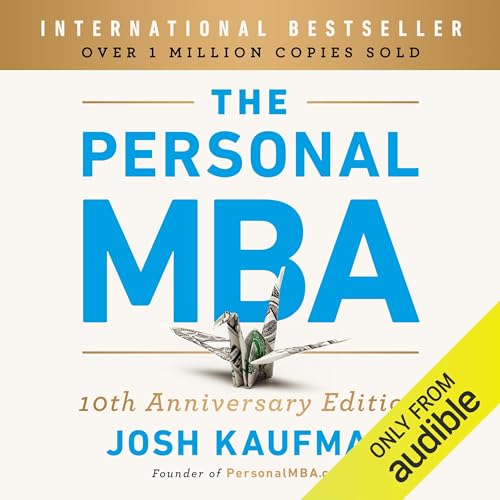
The Personal MBA
4.4 Stars 7,304 Ratings
Core business principles from The Personal MBA:
- Focus on creating genuine value before optimizing marketing or operations
- Understand the five parts of every business: value creation, marketing, sales, delivery, and finance
- Test business ideas quickly and cheaply before committing major resources
- Master pricing psychology to capture more value from what you deliver
What makes The Personal MBA valuable is its breadth combined with actionable depth. Kaufman doesn’t just define concepts. He explains how to apply them immediately to improve your business. Whether you’re evaluating pricing strategies, designing better offers, or understanding financial statements, this book provides frameworks that clarify decision-making. Self-taught entrepreneurs who need structured business knowledge will find this essential listening.
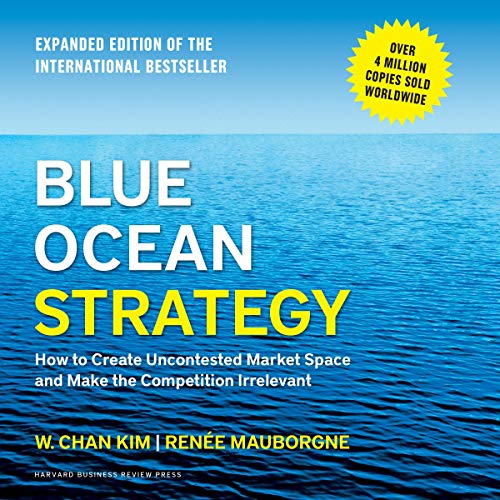
📘 Blue Ocean Strategy — W. Chan Kim & Renée Mauborgne
W. Chan Kim and Renée Mauborgne’s Blue Ocean Strategy introduces a framework for creating uncontested market space instead of competing in crowded industries. The authors studied successful companies across multiple industries and identified patterns in how they innovated. Rather than fighting competitors on price or features, blue ocean strategists reconstruct market boundaries to make competition irrelevant.
The authors cite Cirque du Soleil as a classic example: instead of competing with Ringling Bros. and other circuses in a declining industry, Cirque eliminated animals and star performers (expensive and controversial), added theatrical elements and artistic music, and targeted adult theater-goers willing to pay premium prices. This created an entirely new market where traditional circus competition became meaningless. The result: Cirque generated more revenue in its first 20 years than Ringling Bros. generated in its first 100 years. Research shows that blue ocean launches accounted for only 14 percent of new businesses studied but generated 38 percent of total revenues and 61 percent of total profits.
Blue Ocean Strategy
4.2 Stars 3,620 Ratings
Blue ocean strategy framework:
- Use the strategy canvas to visualize where your industry competes and where it ignores opportunities
- Apply the four actions framework: eliminate, reduce, raise, and create factors of competition
- Target non-customers who avoid your industry because existing offerings don’t meet their needs
- Build business models that make imitation difficult through strategic sequencing
The book provides tools like the strategy canvas and the four actions framework to help you identify where your industry over-serves customers on certain dimensions while under-serving them on others. Entrepreneurs stuck in price wars or commodity markets who need a framework for differentiation will find Blue Ocean Strategy teaches you to compete on value innovation rather than cost reduction.
Leadership And Organizational Insight
Leadership isn’t about titles or charisma. It’s about creating clarity, aligning people around shared goals, and building cultures where talented people want to stay and do their best work. Poor leadership is one of the top reasons businesses fail to scale beyond the founder. As companies grow from solo operations to teams, the entrepreneur’s role shifts from doing the work to enabling others to do the work.
The business audiobook in this section explores what separates effective leaders from those who struggle to build high-performing organizations. It covers how to develop strategic thinking, manage stakeholders, and make decisions when outcomes are uncertain.
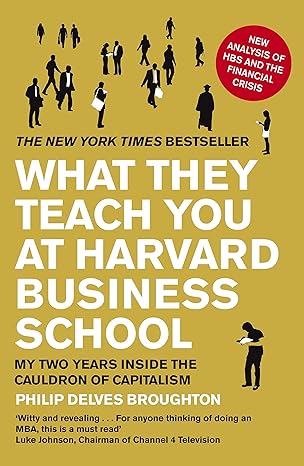
📘 What They Teach You at Harvard Business School — Philip Delves Broughton
Philip Delves Broughton’s What They Teach You at Harvard Business School chronicles his two years in one of the world’s most prestigious MBA programs. Broughton candidly shares what he learned about leadership, negotiation, finance, and organizational behavior while questioning whether the education justified the cost. The book provides an inside look at how elite business schools shape thinking about strategy and management.
Broughton describes a pivotal class where a professor analyzed Warren Buffett’s investment decisions. The lesson wasn’t about finance formulas. It was about patience, discipline, and independent thinking. Buffett passed on the dot-com bubble while peers made billions, then he was vindicated when the bubble burst. The professor noted: “Most MBAs are trained to act decisively and move fast. Buffett’s greatest skill is doing nothing until the perfect opportunity arrives.” This insight challenged everything students assumed about business success. Broughton also reveals that 92 percent of his classmates expected to be CEOs within 10 years—yet statistically, fewer than 1 percent would achieve that goal.
What They Teach You At Harvard Business School
4.4 Stars 480 Ratings
Leadership insights from Harvard Business School:
- Develop patience and discipline to wait for high-probability opportunities instead of forcing action
- Build independent thinking skills to resist following the crowd during market bubbles
- Understand that strategic decisions often mean choosing what NOT to do
- Recognize the gap between MBA ambition and realistic career trajectories
What makes What They Teach You at Harvard Business School valuable is its honest assessment of business education. Broughton doesn’t just report what professors taught. He evaluates which lessons proved useful in real-world application and which remained academic theory. Entrepreneurs considering formal business education or those seeking insights without the time commitment will find this offers a curated view of high-level strategic thinking frameworks.
Decision-Making And Business Psychology
Logic alone doesn’t drive business success. Emotions, biases, and cognitive shortcuts influence every decision from pricing to hiring to strategic pivots. Understanding the psychology behind business decisions helps you avoid common traps like sunk cost fallacy, confirmation bias, and overconfidence. It also helps you predict how customers, competitors, and partners will behave under different conditions.
The business audiobook in this section examines real-world business successes and failures through a psychological lens, revealing the hidden forces that shape outcomes beyond spreadsheets and strategy documents.
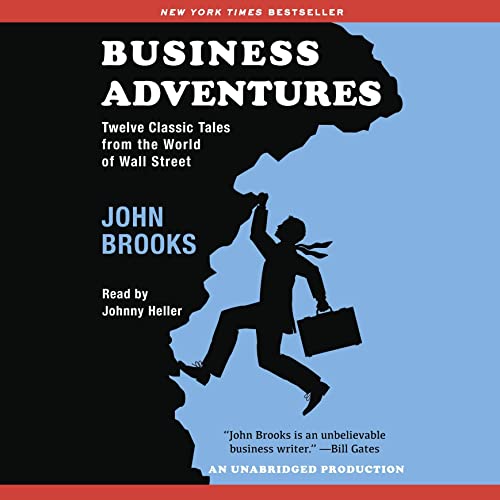
📘 Business Adventures — John Brooks
John Brooks’s Business Adventures is a collection of twelve stories about iconic companies and business events from the 1960s. Despite being written decades ago, the lessons remain timeless: the psychology of market crashes, the challenges of corporate leadership, the consequences of product failures, and the dynamics of business negotiations. Bill Gates and Warren Buffett both cite this as their favorite business book.
Brooks opens with the story of the 1962 Flash Crash when the stock market dropped 6.7 percent in a single day—at the time, the worst decline since 1929. Brooks interviewed traders, executives, and regulators to understand why panic spread so quickly despite strong underlying economic fundamentals. The answer: fear is contagious. When a few large investors started selling, others followed reflexively without understanding why. This same pattern repeats in every market crash since. Brooks writes: “The stock market is not, as we sometimes like to think, a cool, calculating machine. It’s a perpetual popularity contest.” Understanding this emotional reality matters more than mastering technical analysis.
Business Adventures
3.9 Stars 1,377 Ratings
Business psychology lessons from Brooks:
- Recognize that fear and greed drive markets more than fundamentals do
- Study historical business patterns because the same dynamics repeat across decades
- Understand that corporate leadership challenges haven’t fundamentally changed
- Learn to spot emotional contagion in business decisions before it affects your judgment
What makes Business Adventures valuable is how Brooks uses narrative to reveal underlying principles. Rather than prescribing formulas, he shows you how real executives made decisions under pressure and what happened as a result. The stories illustrate that business challenges haven’t fundamentally changed. The same patterns repeat across industries and eras. Brooks develops pattern recognition that helps you see familiar dynamics in unfamiliar situations.
Execution And Growth
Ideas don’t build companies. Execution does. Entrepreneurs who succeed turn strategy into actionable plans with clear milestones, then adapt those plans as reality provides feedback. Growth requires systems for sales, operations, and team management that can handle increasing volume without collapsing under their own weight.
The business audiobook in this section provides a framework for strategic planning that connects where your business is today to where you want it to be in five years.
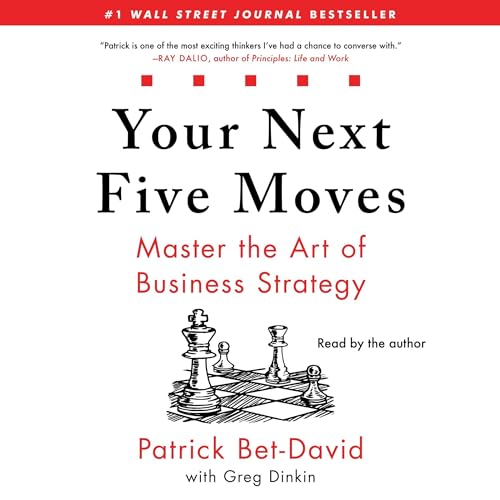
📘 Your Next Five Moves — Patrick Bet-David
Patrick Bet-David’s Your Next Five Moves teaches strategic thinking for entrepreneurs who want to scale from small operations to significant enterprises. Bet-David, founder of a billion-dollar insurance company, shares his framework for planning moves ahead like a chess player. The book covers hiring, sales, raising capital, and making strategic decisions when stakes are high.
Bet-David shares his immigration story: arriving in America from Iran with nothing, joining the military, then building PHP Agency into a financial services powerhouse. His breakthrough came when he stopped thinking one move ahead and started mapping out five moves simultaneously. He describes hiring his first employee: most entrepreneurs hire when overwhelmed, then fire when they can’t afford payroll. Bet-David hired while still uncomfortable with the expense, calculated exactly how much revenue that person needed to generate, then structured compensation to align incentives. That single hire became a $10 million producer. Research shows that strategic planning increases business survival rates by 30 percent, yet most entrepreneurs operate reactively rather than strategically.
Your Next Five Moves: Master the Art of Business Strategy
4.8 Stars 7,141 Ratings
Strategic execution principles from Bet-David:
- Map out five business moves ahead to see how today’s decisions affect future options
- Hire strategically before you’re overwhelmed, with clear revenue expectations per role
- Structure compensation to align team incentives with business growth objectives
- Develop the patience to execute long-term plans despite short-term discomfort
What separates Your Next Five Moves from generic business advice is its focus on sequencing. Bet-David explains how to identify which moves should come first and which depend on earlier steps being complete. He addresses the mental game of entrepreneurship: managing fear, maintaining focus, and developing the patience required for long-term success. Ambitious entrepreneurs who want to think bigger than their current capacity allows will find frameworks for scaling strategically.
Applying Business Lessons Daily
Business audiobooks only create value when you apply what you learn. The gap between consuming content and implementing systems is where most knowledge goes to waste. After finishing a business audiobook, extract three actionable insights and schedule time to implement them within the next week.
For solopreneurs, application might mean documenting your sales process so you can hire help later. For early-stage startups, it might mean redesigning your offer using blue ocean strategy principles. For growing companies, it could mean implementing better leadership practices to retain top talent. The specific actions matter less than the habit of converting knowledge into measurable business improvements.
🚫 Business Mistakes Cheat Sheet
Even smart entrepreneurs make avoidable mistakes that cost them years of progress and thousands in wasted resources. Use this cheat sheet to identify and fix the most common mistakes that stall growth, drain cash, and keep your business stuck at its current size.
| Business Mistake | Why It Stalls Your Growth | The Fix |
|---|---|---|
| Scaling before proving product-market fit | You burn cash on infrastructure and team before validating demand, creating financial pressure | Prove consistent revenue with your first 10-20 customers before adding overhead |
| Copying other businesses without understanding context | What worked for a venture-backed SaaS won’t work for your local service business | Extract principles from case studies but customize execution for your market |
| Chasing revenue growth while ignoring profitability | A business making $1M with no profit is a high-risk job, not a success | Track unit economics and profit margins as closely as revenue numbers |
| Avoiding hard conversations until they become crises | Waiting to address team issues, equity disputes, or strategic conflicts removes your options | Schedule quarterly check-ins to surface tensions while they’re still manageable |
| Operating reactively instead of planning strategically | You spend all your time firefighting with no capacity to build systems | Block one day monthly for strategic planning separate from daily operations |

Book Comparison Table
| Book | Author | Best For | Length | Key Takeaway |
|---|---|---|---|---|
| The Personal MBA | Josh Kaufman | Core business fundamentals without formal education | 11 hours | Master business basics to make better decisions faster |
| Blue Ocean Strategy | W. Chan Kim & Renée Mauborgne | Creating uncontested market space | 6.5 hours | Compete where others aren’t instead of fighting price wars |
| What They Teach You at Harvard Business School | Philip Delves Broughton | Strategic leadership and management thinking | 12 hours | Elite business education focuses on frameworks over formulas |
| Business Adventures | John Brooks | Understanding business psychology through stories | 14 hours | Business patterns repeat across industries and decades |
| Your Next Five Moves | Patrick Bet-David | Strategic planning for ambitious growth | 9.5 hours | Think five moves ahead like a chess player building an empire |
Start Here: Your 3-Step Action Plan
Step 1: Choose Based on Your Business Stage Pick the business audiobook that matches where you are right now. Just starting? Begin with The Personal MBA for fundamentals. Struggling with competition? Try Blue Ocean Strategy. Ready to scale? Start with Your Next Five Moves. Don’t jump ahead to advanced concepts before mastering basics. Build your foundation first.
Step 2: Listen with Revenue Impact in Mind Before starting the audiobook, write down your current monthly revenue and your 12-month revenue goal. Listen with this gap in mind. Every time the author describes a strategy, pause and estimate: “If I implemented this, how much revenue could it generate or save?” Track ideas by potential dollar impact, not just whether they sound interesting. Business audiobooks only matter if they move numbers.
Step 3: Schedule an Implementation Day Block four hours within one week of finishing the audiobook to apply what you learned. Use that time to redesign a process, create a strategic plan, or workshop a new positioning strategy. Treat this implementation session as non-negotiable. Business audiobooks only create value when knowledge turns into action that generates results.
Start Building Your Business Foundation Today
Strategy separates growth from chaos. The five business audiobooks in this guide provide frameworks for thinking strategically about markets, leadership, psychology, and execution. You don’t need all five to start building a better business. Choose the one that addresses your biggest gap, whether that’s foundational knowledge, strategic positioning, or scaling systems.
Entrepreneurs who study proven business frameworks before launching or scaling save themselves years of expensive mistakes. These business audiobooks compress lessons from successful founders and researchers into formats you can absorb during commutes, workouts, or household tasks.
Add these to your playlist and start mastering this skill today.
Ready for Part 5? Understand human behavior and influence with 5 Best Psychology Audiobooks →
🎧 Part of the “25 Audiobooks To Master 5 High-Income Skills” series. Explore all 5 posts to level up your productivity, communication, business, finance, and human insight — one audiobook at a time.