- What Happened: The 62,000-Job Bloodbath
- The Jobs AI Is Targeting Right Now
- Audit Your AI Replacement Risk Right Now
- Build Your Automation-Proof Income Stack
- Frequently Asked Questions
- The AI Job Automation Survival Framework
- Your 90-Day Backup Income Action Plan
- Start Building Your Backup Income Before It’s Too Late
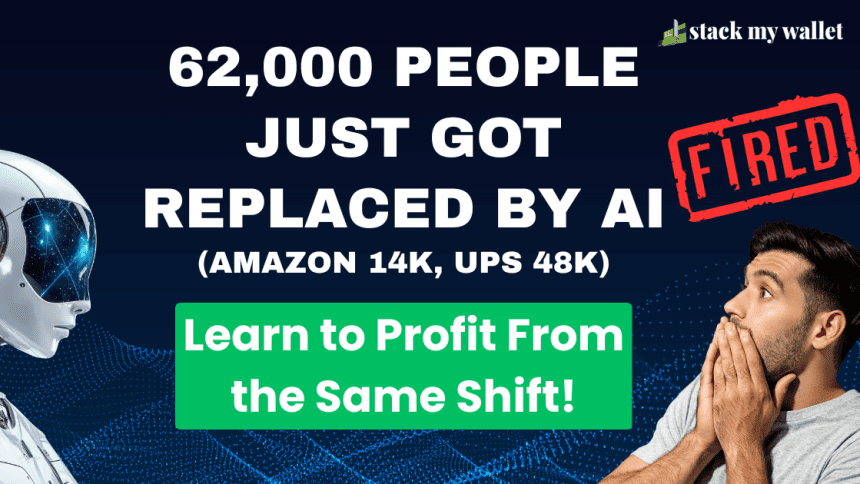
October 28 and 29, 2025, will go down as the two days corporate America shed 62,000 jobs like dead weight. Amazon cut 14,000 positions with whispers of 30,000 more coming. UPS dumped 48,000 workers in nine months. Both companies pointed to the same culprit: AI job automation. CEO Andy Jassy didn’t sugarcoat it—Amazon needs “fewer people doing some of the jobs being done today.” Translation: Your position just became optional. By the end of this article, you’ll know exactly how to audit your AI replacement risk, which skills can’t be automated, and how to build a backup income stream before your employer decides you’re redundant.
What Happened: The 62,000-Job Bloodbath
What Happened:
On October 28, Amazon announced it would eliminate 14,000 corporate positions. Reuters suggested the real number could hit 30,000. The same day, UPS revealed it had cut 48,000 roles over nine months—14,000 in management, 34,000 in operations. These weren’t factory workers or drivers. These were desk jobs. Middle management. Coordinators. Administrative roles. The kind of positions that required college degrees and years of experience. (You know, the “stable” careers your parents told you to pursue.)
Why It Matters:
This isn’t about two companies having bad quarters. This is the beginning of white-collar automation hitting workers who thought they were safe. According to the World Economic Forum, 40% of employers expect to reduce their workforce where AI can automate tasks. Not in five years. Right now.
In the first six months of 2025 alone, 77,999 tech workers lost their jobs directly to AI. That’s 426 people every single day watching algorithms replace them. Middle management got hit hardest because those roles are exactly what AI excels at: coordinating schedules, managing workflows, processing information, and making routine decisions. Translation: If your job is 80% email management and status updates, you’re one GPT upgrade away from obsolescence.
Previous layoffs targeted specific industries or economic downturns. AI job automation is different because it’s coming for every desk job simultaneously. (Factory automation gave you 20 years’ warning. This is giving you 20 months.) The National University research confirms it: By 2030, 30% of current U.S. jobs could be fully automated, while 60% will see significant task-level changes due to AI integration. That means even if you keep your job title, half your responsibilities might vanish, and your employer will expect you to do twice as much with the time you have left. Sure.
How to Stack It:
Stop waiting for permission to build a safety net. The companies laying off 62,000 people in 48 hours aren’t going to warn you when your number comes up. Your move: Audit your current role for AI job automation risk this week. If AI can do 60% or more of your tasks cheaper and faster, you have 12 to 18 months to diversify your income. Not “someday.” This quarter.
The Jobs AI Is Targeting Right Now
Want to know the scary part? Entry-level positions are getting decimated first.
High-Risk Roles (Getting Automated Now):
- Data entry clerks: 95% automation risk (That’s corporate-speak for “pack your desk by Friday.”)
- Customer service reps: 80% automated by end of 2025
- Administrative assistants: Scheduling and coordination tasks replaced
- Bookkeepers: Basic accounting fully automated
- Market research analysts: 53% of tasks AI-replaceable (Bloomberg)
- Sales representatives: 67% of routine tasks automated (Bloomberg)
But here’s where it gets interesting: Software engineers aren’t safe either. Microsoft CEO Satya Nadella revealed that 30% of company code is now AI-written. Then Microsoft laid off software engineers. The company creating the AI is using it to fire the people who understand it best. Period.
Management roles face lower immediate risk (9 to 21% automation potential), but that’s cold comfort when your entire department gets consolidated because AI handles the coordination work. Your promotion path just disappeared because the middle rungs of the ladder no longer exist.
Financial Services Jobs at Risk:
- 70% of basic banking operations automated by 2025
- 200,000 Wall Street positions cut over next 3-5 years
- Loan processors, financial analysts, compliance officers facing workforce displacement
Why Your “Stable” Job Isn’t Actually Stable 🎯
Job security used to mean having specialized skills, years of experience, and a degree. Now it means answering one question: Can AI do this cheaper and faster?
If your daily tasks involve processing documents, managing schedules, generating reports, writing standard communications, or coordinating between departments, you’re vulnerable. Those aren’t specialized skills anymore. Those are Tuesday morning tasks for ChatGPT. (Sorry.)
The barrier to entry for automation is collapsing. Five years ago, replacing a human worker required custom software, implementation costs, and training time. Today, a mid-level manager can subscribe to an AI service for $20 a month and eliminate three positions. The ROI is instant. Your degree doesn’t protect you. Your tenure doesn’t protect you. The only protection is being able to generate revenue that AI can’t replicate or doing work that requires physical presence, complex human judgment, or creative problem-solving in unpredictable environments.
So what’s the actual move here?
Audit Your AI Replacement Risk Right Now
Stop guessing. Here’s how to assess your actual AI job automation risk in under 30 minutes.
What’s happening: Most employees have no idea which of their tasks are automatable until the layoff announcement comes.
Why this matters: Understanding your vulnerability level gives you the lead time to pivot before you’re forced to.
How to stack it: Run this audit today, not next quarter.
Task Breakdown Exercise 📋
List every task you do in a typical work week. Be specific. Not “manage projects,” but “send status update emails,” “compile weekly metrics reports,” “schedule meetings across three time zones,” and “update Excel spreadsheets with sales data.” Now mark each task: Can AI do this today? (Yes/No)
Risk Levels:
- 60%+ AI-replaceable: High risk. Start building exit strategy immediately.
- 30-60% AI-replaceable: Medium risk. You have time, but not infinite time.
- Under 30%: Relatively safe for now, but keep watching.
Translation: Start building your exit strategy immediately if you’re in the high-risk zone.
Revenue Connection Test 💰
Ask yourself: Does my role directly generate revenue, or am I a cost center?
Safer positions: Sales with relationship building, client-facing roles requiring negotiation, revenue-generating specialists
Riskier positions: Operations coordination, administrative support, process management, internal reporting
AI job automation targets cost centers first because eliminating them improves profit margins immediately. (Harsh, but accurate.)
Human Interaction Assessment 🤝
How much of your job requires reading emotional cues, handling conflict, building trust, or navigating political dynamics?
- High human interaction: Lower AI job automation risk
- Low human interaction: Start preparing now
The future of work trends show that automation-proof careers prioritize human connection over task execution.
Build Your Automation-Proof Income Stack
The gig economy isn’t a backup plan anymore. It’s insurance.
What’s happening: According to current data, 36% of Americans now have a side hustle, and the global gig economy is projected to hit $2.15 trillion by 2033. By 2027, nearly 87 million Americans will be freelancing—almost half the workforce.
Why this matters: Building a side income isn’t about entrepreneurial ambition anymore. It’s about survival in an economy where full-time employment is becoming optional.
How to stack it: Launch one income stream this month, not next year.
High-Trust Services That AI Can’t Replicate 🔒
Focus on work that requires judgment, empathy, or expertise in unpredictable situations. These aren’t tasks AI can automate—they’re relationships. (And relationships still require humans. For now.)
Automation-Proof Services:
- Business consulting requiring industry expertise
- Executive coaching with emotional intelligence
- Therapy and counseling (human connection required)
- Complex project management with stakeholder navigation
- High-touch client services needing trust building
Skill-Based Freelancing 💼
The highest-paid gig workers earn over $100,000 annually. They’re not driving for Uber. They’re offering specialized skills. This is where solopreneur growth happens—charging for expertise, not hours.
High-Value Freelance Skills:
- Copywriting that understands brand voice and psychology
- Graphic design solving business problems
- Web development with client communication
- Fractional CFO or marketing director roles
- Strategic consulting in your industry expertise
Pick one skill, get good at it, and start charging. Wild.
Digital Products and Courses 📚
Create once, sell forever. The barrier to entry is low. (You don’t need to be an expert—you just need to know more than your target customer.)
Digital Product Options:
- Online courses teaching your specialty
- Templates for common business problems
- Industry-specific resources and tools
- Automated consulting frameworks
- Downloadable guides and checklists
The 90-Day Side Income Blueprint 🎯
Most people fail at building side income because they start with no plan and quit after three weeks. Here’s the structured approach that actually works.
Choose Your Lane: Weeks 1-2
- Pick one income stream based on existing skills
- Don’t start three businesses. Start one.
- Identify five people who would pay for your service
- Validate demand exists before building anything
First Revenue: Weeks 3-6
- Launch a simple offer (service + price, no website needed)
- Get your first three paying clients
- Prove the concept and generate cash flow
- Collect testimonials for future marketing
Systematize: Weeks 7-10
- Document your delivery process
- Create templates for repetitive tasks
- Build simple client onboarding workflow
- Deliver consistent results without reinventing the wheel
Scale Testing: Weeks 11-12
- Raise your prices by 20%
- Add a second service for existing clients
- Test one marketing channel (LinkedIn, email, digital entrepreneurship content)
- Track what works and double down
Look, I’m not saying this is easy. But it’s easier than explaining to your family why you didn’t see the layoff coming.
Frequently Asked Questions
| Question | Answer |
|---|---|
| How long do I have before AI replaces my job? | If your role is 60%+ automatable, 12-18 months. Medium risk (30-60%) gives you 2-3 years. But timelines are accelerating—plan now, not later. |
| What jobs are truly safe from AI automation? | Physical trades (construction, plumbing, electrical), healthcare roles requiring human touch (nursing, therapy), and creative work needing human judgment (strategy, design). |
| Can I compete with AI as a freelancer? | Yes—by focusing on work requiring trust, empathy, and complex judgment. AI handles tasks. You handle relationships and strategic decisions. |
| How much should I save before leaving my job? | 6 months of expenses minimum. But don’t wait for perfect conditions—build side income first, then transition when it replaces 50% of your salary. |
| What’s the fastest way to start earning side income? | Offer a service you already know how to do. Skip the learning curve, skip the startup costs. Just sell what you’re good at to people who need it. |
| Should I learn AI skills to stay relevant? | Only if it makes you more valuable in your current role or side business. Don’t learn AI just to avoid displacement—learn it to increase output and charge more. |
| How do I know if my side hustle idea will work? | Find five people who would pay for it. If you can’t find five, it’s not a business—it’s a hobby. Validate demand before building anything. |
| What if I don’t have time for a side hustle? | You have 8-10 hours a week. Everyone does. The question is whether you’ll use them on Netflix or building income insurance. Your call. |
The AI Job Automation Survival Framework
| What Happened | Why It Matters | How to Stack It |
|---|---|---|
| Amazon cut 14K jobs, UPS cut 48K jobs in 48 hours, both citing AI automation as the reason | 40% of employers plan to reduce workforce where AI can automate tasks. 77,999 tech workers lost jobs to AI in first 6 months of 2025. This is the beginning of mass white-collar displacement. | Audit your role for automation risk this week. If 60%+ of your tasks are AI-replaceable, start building side income immediately. You have 12-18 months. |
| Middle management and operations roles hit hardest by layoffs | These positions coordinate workflows and process information—exactly what AI excels at. Your promotion path is disappearing because the ladder has fewer rungs. | Focus on high-trust work requiring human judgment: consulting, coaching, complex project management. Build relationships AI can’t replicate. |
| Entry-level positions face 95% automation risk in some fields | Data entry, customer service, administrative roles being eliminated first. AI does these tasks faster and cheaper than humans. Future of work trends show task-based roles disappearing. | Launch skill-based freelancing in copywriting, design, web development, or fractional executive roles. Charge for expertise, not tasks. |
| The gig economy grew to $556.7 billion in 2024, projected to hit $2.15 trillion by 2033 | 36% of Americans now have side hustles. By 2027, nearly half the workforce will be freelancing. This isn’t optional—it’s survival insurance in an automated economy. | Pick one service you can sell today. Get 3 paying clients in 4 weeks. Build to $2K-5K/month before the next layoff wave hits. |

Your 90-Day Backup Income Action Plan
The next 62,000 job cuts won’t come with advance warning. You’ll get a calendar invite, a script about “organizational efficiency,” and two weeks to clear your desk. This checklist is your insurance policy. Follow it before you need it, not after. Print it. Check it off. Build your safety net while you still have a paycheck.
Phase 1: Risk Assessment
[ ] List every task you do in a typical work week
[ ] Mark each task as AI-replaceable or not
[ ] Calculate your automation risk percentage
[ ] Identify which tasks generate revenue vs. cost
💪 Nice. Most people never do this reality check.
Phase 2: Skill Inventory
[ ] Write down 5 skills you have that others would pay for
[ ] Narrow to the 1 skill with highest demand in your network
[ ] Research what others charge for similar services
[ ] Find 5 people who might need your service
🎯 This is where clarity beats confusion.
Phase 3: Income Diversification
[ ] Create a simple service offer with clear pricing
[ ] Reach out to 10 potential clients in your network
[ ] Get your first 3 paying clients (even at low rates)
[ ] Document your process for delivering results
🔥 You’re ahead of 80% of people who just talk about it.
Phase 4: Launch & Test
[ ] Deliver excellent results to first 3 clients
[ ] Ask for testimonials and referrals
[ ] Raise your prices by 20%
[ ] Test one new marketing channel (LinkedIn, email, content)
📈 The compound effect starts here. Keep going.
📋 Print this checklist and check off items as you complete them.
Start Building Your Backup Income Before It’s Too Late
The 62,000 people who lost their jobs in October didn’t get a warning. They got a Zoom meeting and a severance package. Maybe it was generous. Maybe it wasn’t. Either way, they’re updating LinkedIn profiles and explaining gaps in their resumes while AI job automation continues accelerating.
You don’t have to be one of them. The difference between watching this happen and surviving it is simple: Start building before you’re forced to. Audit your risk this week. Launch your first side income offer this month. Get three paying clients this quarter.
Corporate America will keep optimizing. AI will keep improving. The layoffs will keep coming. Your backup plan is the only variable you control.
Your move: Pick one skill, find five potential clients, and make your first $1,000 in side income before the end of the year. Or don’t. But when the next 62,000 jobs disappear, make sure yours isn’t one of them.