📚 Part of the “25 Audiobooks To Master 5 High-Income Skills” Series
Part 3 of 5 Personal Finance Audiobooks | Previously: Productivity Audiobooks ← • Communication Audiobooks ←
The Skill That Multiplies Every Other
Financial literacy amplifies every other skill you develop. You can master productivity, communication, and business strategy, but without understanding how money works, you’ll struggle to convert effort into lasting wealth. According to the National Foundation for Credit Counseling’s 2024 survey, 47 percent of U.S. adults rate their personal finance knowledge as a grade of C or worse. Meanwhile, the Federal Reserve reports that only 72 percent of adults feel at least okay financially, down from 78 percent just a few years ago.
This knowledge gap costs people dearly. Small business owners with low financial literacy report losing an average of $10,000 or more in profits due to poor money management decisions. On the flip side, financial education creates measurable improvements: participants who complete basic financial education programs see credit score increases ranging from 11 to 32 points within three years.
Personal finance audiobooks give you the frameworks to go from where you are financially to where you want to be. They provide strategies for managing money, building wealth, and making investment decisions without requiring you to sit through courses or hire expensive advisors. The five personal finance audiobooks in this guide cover everything from mindset shifts and wealth psychology to practical investing strategies and business leverage.
The Power of Financial Literacy
Financial literacy means understanding how money flows, grows, and compounds over time. It’s knowing the difference between assets that generate income and liabilities that drain it. It’s recognizing when debt accelerates your goals versus when it traps you in a cycle of payments. Most importantly, financial literacy gives you the confidence to make decisions that align with your long-term goals rather than reacting to short-term emotions.
The data shows that financial literacy improves with intentional learning. Only 57 percent of U.S. adults can correctly answer three out of five basic financial literacy questions, which means nearly half the population lacks fundamental money knowledge. Research from the TIAA Institute shows that financial literacy levels are lowest among Gen Z, with only 37 percent answering basic questions correctly. This knowledge gap creates opportunity for those who commit to learning. Personal finance audiobooks provide an accessible entry point for building this knowledge base without the barriers of formal education or expensive courses.
Why Learn Finance Through Audiobooks?
Money education through audiobooks removes the visual intimidation of spreadsheets, formulas, and dense financial charts. When someone explains compound interest verbally with real examples, it clicks faster than staring at equations on a page. You hear the logic behind financial decisions without getting lost in tables and graphs that make your eyes glaze over.
Audiobooks also let you learn about money privately, without the shame many people feel admitting they don’t understand basic finance concepts. There’s no judgment when you’re listening alone in your car. You can rewind complex topics like tax strategies or index fund allocation as many times as you need without feeling stupid. For solopreneurs juggling multiple priorities, audiobooks fit into dead time—commutes, workouts, household tasks—turning wasted hours into financial education that compounds your earning power.
Wealth Mindset And Abundance Thinking
Your relationship with money starts in your mind. If you believe wealth is reserved for other people or that making money requires sacrificing your values, you’ll unconsciously sabotage opportunities. Wealth mindset isn’t about positive thinking or manifestation. It’s about recognizing mental barriers that prevent you from taking calculated risks, negotiating higher pay, or investing in assets that appreciate over time.
The personal finance audiobooks in this section challenge conventional wisdom about how wealth gets built. They expose the myths that keep people stuck in jobs they hate or businesses that barely break even. These books teach you to think like an owner, not an employee, and to view money as a tool for creating freedom rather than a scarce resource to hoard.
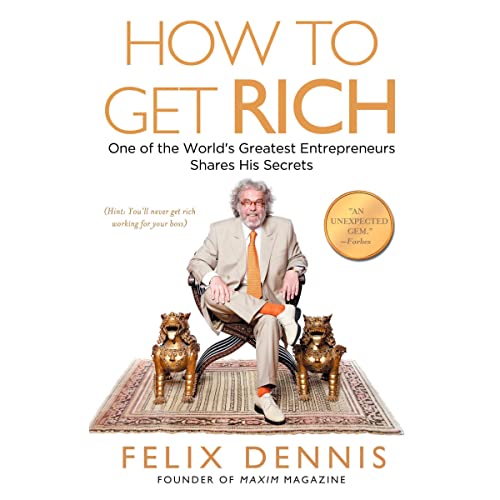
📘 How to Get Rich — Felix Dennis
Felix Dennis’s How to Get Rich is an unfiltered look at wealth-building from someone who built a fortune from scratch. Dennis founded multiple magazines and became worth hundreds of millions by his death. The book is raw, honest, and direct about what it takes to accumulate significant wealth. Dennis doesn’t sugarcoat the sacrifices, risks, or failures involved in building businesses.
Dennis opens with a provocative statement: “If you are unwilling to fail, sometimes publicly, and even catastrophically, you stand very little chance of ever getting rich.” He shares his own story of nearly going bankrupt three times before achieving success, losing relationships and health along the way. Dennis estimates that only about 1 in 100 people have the psychological makeup required to become wealthy—not because of talent, but because most people aren’t willing to sacrifice comfort and security for uncertain payoffs.
How to Get Rich
4.8 Stars 1,112 Ratings
Wealth-building principles from How to Get Rich:
- Accept that wealth requires obsessive focus and willingness to sacrifice comfort temporarily
- Embrace failure as feedback rather than a reason to quit your pursuit
- Understand the psychological toll of wealth-building before you start the journey
- Know exactly why you want wealth so you don’t chase money for its own sake
What makes How to Get Rich valuable is its refusal to sell you unrealistic promises. Dennis explains that getting rich requires obsessive focus, tolerance for failure, and willingness to outwork your competition. He also addresses the psychological toll of wealth-building and the importance of knowing why you’re chasing money in the first place. For anyone seeking motivation without the motivational speaker fluff, Dennis delivers unfiltered truth.
📘 The Millionaire Fastlane — M.J. DeMarco
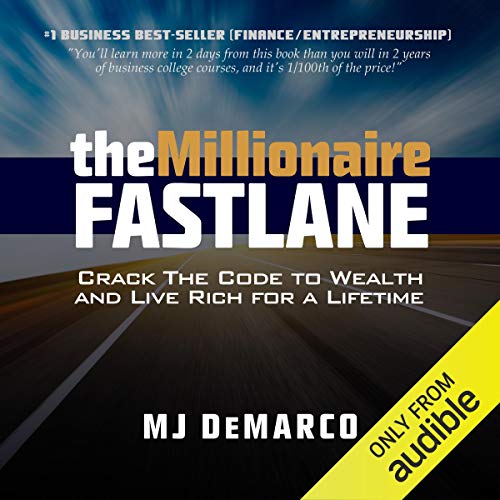
M.J. DeMarco’s The Millionaire Fastlane challenges the traditional slow-lane wealth-building advice of saving 10 percent and retiring at 65. DeMarco argues that real wealth comes from building scalable businesses that create value at scale rather than trading time for money in a job. The book introduces the concept of the fastlane, which prioritizes leverage, systems, and exponential growth over incremental savings.
DeMarco shares his breakthrough moment: sitting in a Lamborghini at age 33, watching a man exit the car, and asking him what he did for a living. The man replied, “I’m an inventor.” That conversation shattered DeMarco’s belief that wealth required decades of corporate ladder-climbing. He calculated that saving $100 per month with 8 percent returns would take 40 years to reach $1 million—but one successful business could achieve that in 5 years. He calls traditional financial advice “Get Rich Slow,” which mathematically can’t work when inflation and life expectancy are factored in.
The Millionaire Fastlane
4.7 Stars 8,743 Ratings
Fastlane wealth strategies from DeMarco:
- Build scalable systems that generate income without requiring your constant time input
- Focus on creating value at scale rather than trading hours for dollars
- Calculate the math on traditional savings plans to see why they fail most people
- Use business ownership and leverage to accelerate wealth-building timelines
DeMarco breaks down the math behind why traditional retirement planning fails for most people and provides an alternative framework focused on entrepreneurship and asset building. Solopreneurs and side hustlers who recognize they can’t save their way to wealth on a W-2 income alone will appreciate the blueprint for accelerating income through business ownership rather than waiting decades for compound interest to work its magic.
Money Management And Behavior
Knowing what to do with money is only half the battle. The other half is managing your behavior when emotions run high. Fear drives people to sell investments at market bottoms. Greed pushes them to chase speculative assets at peaks. Social pressure convinces them to spend on things they don’t need to impress people they don’t like. Money management starts with understanding your own psychological triggers.
The personal finance audiobooks in this section explore the behavioral side of wealth-building. They teach you how to recognize emotional spending patterns, automate good financial habits, and make decisions based on long-term strategy rather than short-term impulses.
📘 The Psychology of Money — Morgan Housel
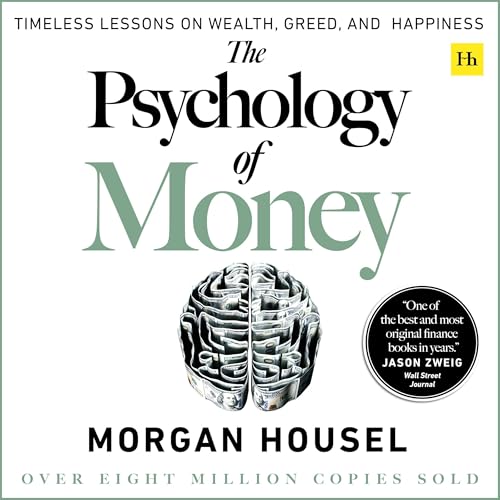
Morgan Housel’s The Psychology of Money examines how people think about and interact with money through the lens of behavioral psychology. Housel uses stories and case studies to illustrate key principles like the power of compounding, the role of luck versus skill, and why wealth is what you don’t see. The book emphasizes that financial success depends more on behavior than intelligence.
Housel tells the contrasting stories of Ronald Read, a janitor who accumulated $8 million through frugal living and patient investing, and Richard Fuscone, a Harvard-educated Merrill Lynch executive who went bankrupt despite earning millions. The difference wasn’t intelligence or income. It was behavior. Housel writes: “Doing well with money has little to do with how smart you are and a lot to do with how you behave. And behavior is hard to teach, even to really smart people.” Research shows that people with modest incomes but disciplined savings habits often accumulate more wealth than high earners with expensive lifestyles.
The Psychology of Money
4.8 Stars 24,064 Ratings
Behavioral finance lessons from Housel:
- Recognize that behavior matters more than intelligence when building wealth
- Practice patience because compound interest requires decades to show dramatic results
- Avoid lifestyle inflation that keeps pace with income increases
- Focus on not losing money rather than chasing maximum returns
Housel explains why people with high incomes often have little wealth while others with modest incomes build substantial net worth. The difference comes down to spending discipline, patience, and avoiding catastrophic mistakes. Anyone who intellectually understands money principles but struggles to apply them consistently will find The Psychology of Money helps you apply what you know.
📘 Rich Dad Poor Dad — Robert T. Kiyosaki
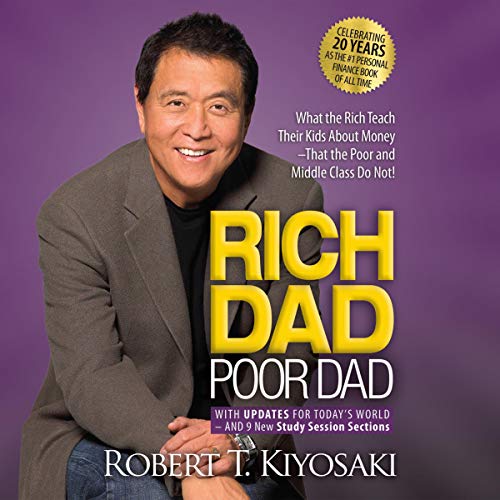
Robert Kiyosaki’s Rich Dad Poor Dad contrasts the financial philosophies of his two father figures: his biological father (Poor Dad) who valued education and job security, and his best friend’s father (Rich Dad) who built wealth through businesses and real estate. Kiyosaki uses this framework to explain the difference between working for money and having money work for you.
Kiyosaki shares a pivotal childhood lesson: at age nine, he and his friend Mike worked in Rich Dad’s store for 10 cents an hour. After weeks of frustration, Kiyosaki demanded a raise. Rich Dad refused and instead stopped paying him entirely, forcing him to find ways to make the business work for him rather than trading time for money. This lesson—that the poor and middle class work for money while the rich make money work for them—became the foundation of Kiyosaki’s wealth philosophy. He emphasizes that his highly educated Poor Dad retired with little wealth despite a good salary, while Rich Dad, who never finished high school, died one of Hawaii’s richest men.
Rich Dad Poor Dad
4.8 Stars 18,600 Ratings
Core wealth concepts from Rich Dad Poor Dad:
- Distinguish between assets that put money in your pocket and liabilities that take money out
- Prioritize acquiring income-generating assets like rental properties and businesses
- Understand that traditional education doesn’t teach financial literacy or wealth-building
- Make your money work for you through investments rather than only working for money
The book teaches fundamental concepts like assets versus liabilities, the importance of financial education, and why traditional schooling doesn’t prepare people for wealth-building. Kiyosaki emphasizes acquiring income-generating assets like rental properties, businesses, and investments rather than accumulating possessions that drain cash flow. Rich Dad Poor Dad shifts how you categorize purchases and helps you prioritize investments that compound over time.
Investing Simplified
Investing intimidates people because it feels complex and risky. The financial industry profits from this confusion by selling complicated products and charging high fees for advice that often underperforms simple strategies. The truth is that investing for wealth-building doesn’t require day trading, stock picking, or market timing. It requires understanding a few core principles and executing them consistently over decades.
The personal finance audiobook in this section strips investing down to its essentials. It provides a straightforward path to building wealth through low-cost index funds and long-term holding strategies that anyone can implement.
📘 The Simple Path to Wealth — J.L. Collins
J.L. Collins’s The Simple Path to Wealth offers a no-nonsense approach to investing built around low-cost index funds. Collins argues that most people overcomplicate investing by chasing performance, trying to time markets, or paying financial advisors for strategies they could implement themselves. His recommendation is simple: invest consistently in a total market index fund, avoid debt, and stay the course through market volatility.
Collins wrote the book as a series of letters to his daughter, explaining what she needed to know about money. He shares a powerful statistic: from 1975 to 2015, the S&P 500 returned an average of 11.9 percent annually—but the average investor only earned 3.7 percent because they bought high during bubbles and sold low during crashes. The enemy isn’t market volatility; it’s emotional decision-making. Collins advocates for automating investments to remove emotions entirely. He also debunks the myth that you need to be wealthy to invest, noting that someone who invests $200 monthly from age 25 to 65 with 10 percent returns will accumulate over $1 million.
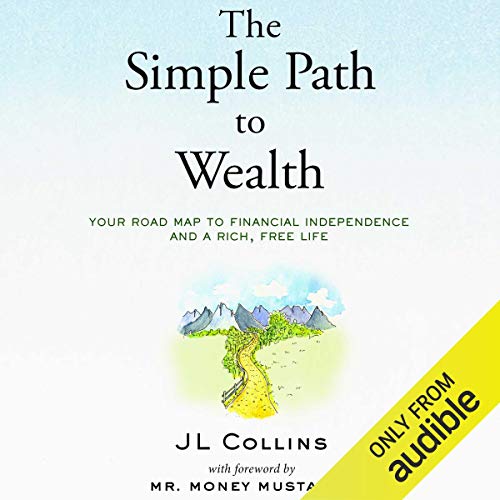
The Simple Path to Wealth
4.8 Stars 9,851 Ratings
Simple investing strategies from Collins:
- Invest consistently in low-cost total market index funds rather than picking individual stocks
- Automate your investments to remove emotional decision-making from the process
- Stay invested through market crashes because time in the market beats timing the market
- Start with whatever amount you can afford rather than waiting until you have more money
The book explains compound interest, the power of dollar-cost averaging, and why time in the market beats timing the market. Collins also addresses common fears about market crashes and provides historical context showing how markets recover over time. Anyone who wants to build wealth through investing but feels overwhelmed by the options will find The Simple Path to Wealth delivers exactly what it promises: a clear, actionable plan you can start today.
Applying Financial Knowledge
Reading personal finance audiobooks doesn’t build wealth. Applying what you learn does. The gap between knowledge and action is where most people get stuck. They understand they should save more, invest regularly, and avoid bad debt, but they don’t create systems that make these behaviors automatic. Financial success requires translating concepts into daily habits and monthly routines.
Start with three foundational steps: build a small emergency fund, automate your savings and investments, and eliminate high-interest debt. These actions create a stable foundation for everything else. Once you have breathing room, focus on increasing income through side hustles or business ventures while continuing to invest consistently.
🚫 Financial Mistakes Cheat Sheet
Even financially literate people fall into traps that derail their wealth-building progress. Use this cheat sheet to identify and fix the most common mistakes that keep you broke, stressed, and stuck in financial cycles that go nowhere.
| Financial Mistake | Why It Kills Your Wealth | The Fix |
|---|---|---|
| Lifestyle inflation when income increases | Your spending rises with every raise, leaving no room for wealth accumulation | Maintain your current lifestyle and invest income increases instead |
| Overcomplicating your financial strategy | Too many accounts, investments, and projects create confusion without adding value | Stick to 2-3 proven strategies and automate everything possible |
| Investing in things you don’t understand | Chasing trends and hype leads to losses that wipe out your progress | Only invest in assets you can explain clearly to someone else |
| Waiting for perfect conditions to start | Market uncertainty and life chaos never disappear, so you never begin | Start where you are with what you have and adjust as you learn |
| Ignoring the psychological side of money | You make emotional decisions that contradict your long-term strategy | Track your spending triggers and automate good financial behaviors |
Book Comparison Table
| Book | Author | Best For | Length | Key Takeaway |
|---|---|---|---|---|
| How to Get Rich | Felix Dennis | Entrepreneurial mindset and unfiltered wealth truth | 9 hours | Wealth requires obsessive focus and tolerance for risk |
| The Millionaire Fastlane | M.J. DeMarco | Fast-tracking wealth through business leverage | 11 hours | Build scalable systems instead of trading time for money |
| The Psychology of Money | Morgan Housel | Understanding behavioral finance and patience | 5.5 hours | Financial success depends more on behavior than intelligence |
| Rich Dad Poor Dad | Robert T. Kiyosaki | Assets vs liabilities and cashflow thinking | 6 hours | Acquire income-generating assets instead of liabilities |
| The Simple Path to Wealth | J.L. Collins | Index fund investing made simple | 7 hours | Consistent low-cost index investing beats complex strategies |

Start Here: Your 3-Step Action Plan
Step 1: Assess Your Financial Starting Point Choose the personal finance audiobook that addresses your biggest knowledge gap. Need mindset shifts? Start with How to Get Rich or The Millionaire Fastlane. Struggling with behavior? Try The Psychology of Money. Ready to invest but don’t know how? Go with The Simple Path to Wealth. Be honest about where you need the most help.
Step 2: Listen with Your Numbers in Mind Download your chosen personal finance audiobook and listen with your current numbers in mind. Pull up your bank statements, credit card balances, or investment accounts while listening. When the author mentions a percentage, formula, or strategy, pause and calculate how it applies to your actual financial situation. Track specific dollar amounts and action items, not vague concepts.
Step 3: Implement One Financial Habit This Month Take one concept from the audiobook and turn it into a monthly habit. Automate 10 percent of your income into investments. Track your spending for 30 days. Research one business idea you could launch as a side hustle. Pick something concrete, set a deadline, and execute. Financial knowledge without action is just entertainment.
Start Building Your Financial Foundation Today
Wealth grows from knowledge and consistent action. The five personal finance audiobooks in this guide provide frameworks for shifting your money mindset, managing your behavior, and investing for long-term growth. You don’t need all five to start building wealth. Choose the one that addresses your biggest barrier, whether that’s mindset, knowledge, or strategy.
Solopreneurs and entrepreneurs who master money principles outperform those who focus only on revenue growth. Understanding how to keep, invest, and multiply what you earn matters as much as how much you make. These personal finance audiobooks compress decades of hard-won lessons into formats you can absorb while commuting, exercising, or handling household tasks.
Add these to your playlist and start mastering this skill today.
🎧 Part of the “25 Audiobooks To Master 5 High-Income Skills” series. Explore all 5 posts to level up your productivity, communication, business, finance, and human insight — one audiobook at a time.