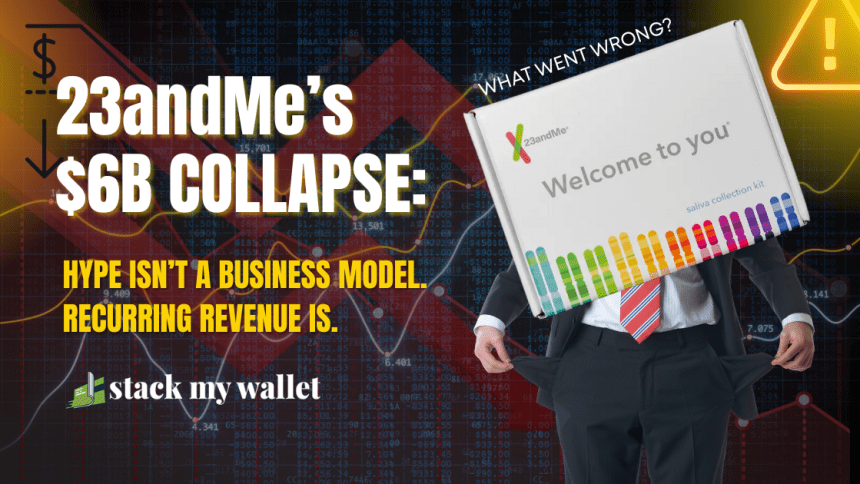
Remember when 23andMe was the hot stock everyone wanted? The genetic testing company that would revolutionize healthcare and unlock the secrets of DNA? Yeah, about that. In March 2025, 23andMe filed for bankruptcy and was sold to Regeneron Pharmaceuticals for $256 million—down from a $6 billion valuation just four years earlier. That’s a 96% value collapse. Translation: sustainable business growth requires more than hype and a viral moment.
By the end, you’ll know how to build sustainable business growth that survives what 23andMe couldn’t—growth backed by recurring revenue, defensible margins, and unit economics that actually work.
From Unicorn to Fire Sale: The $6 Billion Wipeout
23andMe went public in 2021 via SPAC merger with a valuation of $6 billion. Fast forward to March 2025: bankruptcy filing. The company was sold to Regeneron for $256 million. The stock dropped 98% between 2021 and late 2024. Sure.
What happened?
- Declining DNA test kit sales as the market saturated
- Massive 2023 data breach affecting 6.9 million users
- Increased competition from cheaper alternatives
- Lost partnerships and revenue streams
But here’s the real issue: 23andMe had customers, not sustainable business growth. They sold DNA kits. Once. People bought the test, got their results, and never came back. (Turns out, your DNA doesn’t change. Who knew?) No recurring revenue, no repeat purchases, no path to profitability.
The company burned through cash trying to pivot into therapeutics and research partnerships, but it was too late. When your core product is a one-time purchase and your valuation depends on customer acquisition that never pays back, you’re not building a business. You’re accelerating toward bankruptcy.
The Real Problem: No Recurring Revenue Model
Here’s what kills most startups: they confuse sales with sustainable business growth. 23andMe proved you can have millions of customers and still go bankrupt. Why? Because DNA testing is a one-time purchase. You spit in a tube, mail it back, get your results, and never come back.
Translation: customer acquisition costs never get recovered. According to recent data, 82% of businesses that fail do so because of cash flow problems. When you spend $100 to acquire a customer who only pays you $99 once, your unit economics are broken. (And no, “we’ll make it up in volume” doesn’t fix negative math.) Period.
Recurring revenue models work because customers pay you repeatedly over time. Subscriptions, memberships, annual contracts—these create predictable income that funds operations and growth. SaaS companies built their entire industry on it. Netflix lives by it. 23andMe ignored it, and Wall Street rewarded the story until the story stopped making money. That’s the difference between hype and sustainable business growth.
The Three Fundamentals 23andMe Ignored
If you want sustainable business growth that lasts, you need three things: recurring revenue, defensible margins, and profitable unit economics. 23andMe had none of them. Let’s break down what went wrong and how to get it right.
Recurring Revenue: The Real Test 💰
Your business model should answer one question: will customers buy from you again? If the answer is no, you don’t have a business—you have a product. Recurring revenue creates predictability. It lets you forecast cash flow, plan for growth, and survive rough months without panic. (This is the part most founders skip before they start spending on ads.) According to data on startup failures, 90% of startups ultimately fail, and 42% fail because there’s no market need for repeated purchases. That’s not sustainable business growth. That’s hope disguised as strategy.
Build revenue streams that repeat:
- Monthly or annual subscriptions for ongoing access
- Usage-based billing that charges as customers consume
- Service contracts that renew automatically
- Membership models with exclusive benefits
The key is designing your offering so customers need you more than once. If your product solves a problem that only needs solving once, you’re not building sustainable business growth.
Defensible Margins: Can You Survive Competition? 🛡️
23andMe’s margins collapsed when competitors flooded the market with cheaper DNA kits. Suddenly, the $99 test was competing with $49 alternatives. With no brand loyalty, no switching costs, and identical products, customers went with the cheaper option. (When everything’s the same, price wins. Every time.) Wild.
Defensible margins mean you can maintain pricing power even when competitors show up. Translation: you can charge what you’re worth without customers running to whoever’s cheapest. This comes from unique value, network effects, or switching costs that make it expensive for customers to leave. If your only advantage is being first to market, you don’t have defensible margins. You have a head start that won’t last. Sustainable business growth requires margins that survive the inevitable competition.
Create switching costs that keep customers:
- Proprietary data or insights competitors can’t replicate
- Deep integrations into their existing workflows
- Community or network effects that grow with users
- Specialized expertise or support that takes years to build
Price based on value delivered, not features. Control your costs without sacrificing quality. If someone can undercut you by 20% and take your customers, your margins aren’t defensible.
Unit Economics: Math That Actually Works 📊
Here’s the math that killed 23andMe: if it costs $100 to acquire a customer who pays $99 once, you lose money on every sale. Scale doesn’t fix this. You just lose money faster. (More customers times negative profit still equals broke.) Unit economics measure profit or loss per customer. The standard target is 3:1—customers should generate three times what you spend to acquire them. This is how you build sustainable business growth that actually lasts.
Calculate your customer lifetime value (total revenue per customer over their entire relationship with you). Subtract your customer acquisition cost (marketing, sales, onboarding). If the result is negative or barely positive, stop scaling immediately. Fix the economics first. Growth amplifies whatever unit economics you have. If they’re broken, growth accelerates your death.
What Happened → Why It Matters → How to Stack It
| What Happened | Why It Matters | How to Stack It |
|---|---|---|
| 23andMe valued at $6B in 2021, sold for $256M in 2025 after bankruptcy. Stock dropped 98%. | Valuations built on hype collapse fast. Without recurring revenue, customer acquisition costs never get recovered. | Test your model: If you spend $100 to acquire a customer who pays $99 once, you’re losing money. Target 3:1 ratio minimum—$300 lifetime value per $100 acquisition cost. |
| DNA tests are one-time purchases. No repeat customers. No recurring revenue model to sustain operations. | 82% of businesses fail due to cash flow problems. One-time revenue can’t fund growth or survive rough months. | Build monthly subscriptions, annual contracts, or usage-based billing. Revenue that repeats = predictable cash flow = sustainable business growth. Track: do 30%+ customers return within 90 days? |
| Competition increased. Margins collapsed. 23andMe’s $99 kit competed with $49 alternatives. | When price is your only differentiator, you lose. Cheap competitors killed 23andMe’s pricing power and margins. | Create switching costs: proprietary data, deep integrations, community effects. Price on value delivered. Make it expensive (time, risk, effort) for customers to leave. |
Frequently Asked Questions
| Question | Answer |
|---|---|
| Why did 23andMe fail? | No recurring revenue. DNA tests are one-time purchases, so customer acquisition costs were never recovered. |
| What is sustainable business growth? | Growth backed by recurring revenue, defensible margins, and profitable unit economics—not hype or valuation. |
| How much did 23andMe lose in value? | $5.74 billion. The company collapsed from $6 billion in 2021 to $256 million in 2025—a 96% loss. |
| What percentage of startups fail? | 90% of startups ultimately fail. Main causes: no market need (42%) and running out of cash (29%). |
| What is a recurring revenue model? | Customers pay repeatedly over time (subscriptions, memberships) instead of one-time purchases. Predictable income = sustainable growth. |
| What are unit economics? | The profit or loss on a single customer. If acquiring one customer costs more than their lifetime value, you’re losing money. |
Build a Profitable Business Foundation
Most businesses chase revenue without fixing their foundation. You’re not building sustainable business growth if customers only buy once, margins collapse under pressure, and unit economics don’t work. This checklist builds the three fundamentals 23andMe ignored.
Phase 1: Revenue Model
[ ] Calculate customer lifetime value vs acquisition cost (target 3:1 minimum)
[ ] Choose recurring revenue model (subscriptions, memberships, usage-based)
[ ] Set up recurring payment processing
💪 Nice. You’re doing the math most founders skip.
Phase 2: Margin Defense
[ ] Calculate true cost per customer (acquisition + service + support)
[ ] Price based on value delivered, not competitor pricing
🎯 This is where you stop competing on price alone.
Phase 3: Unit Economics
[ ] Track profit per customer monthly
[ ] Fix broken economics before spending on growth
📈 Now you’re running a real business, not a cash bonfire.
📋 Print this checklist and check off items as you complete them.

Build Your Sustainable Business Growth System in 2025
23andMe proved that $6 billion valuations mean nothing without fundamentals. Hype fades. Viral moments end. What survives? Businesses built on recurring revenue, defensible margins, and unit economics that work from day one. The companies that make it aren’t the ones with the biggest funding rounds or the flashiest launches. (Look, I’m not saying every unicorn is doomed. But I’m also not betting on companies that ignore the math.) They’re the ones that solve real problems, charge for value, and get customers to come back.
Companies like South End Capital and National Business Capital fund businesses with proven fundamentals—not valuation hype. They want to see unit economics that work and revenue that repeats, because those are the only things that predict survival. That’s sustainable business growth.
Your move: stop chasing valuation and start building sustainable business growth. Make sure customers buy repeatedly, margins hold under pressure, and unit economics work before you scale. That’s how you build sustainable business growth that lasts beyond the hype cycle.
Next: Print the checklist and validate your revenue model this week.